This battle was fought from the 16th of April 1945 to the 2nd of May 1945 this was Adolf Hitlers last stand it started when Stalin unleashed 20 Armies about 2,500,000 Men, 6,300 Tanks and 8,500 Aircraft. The German’s defended desperately they even recruited children from the age of 14 many from the Hitler youth. One of these boys was Willi Hubner who was only 16 but for his brave service was awarded the Iron Cross during the battle. The result was a Soviet Victory. I recommend to search for more detail!
The Wars of German Unification
These wars were a plan by Otto von Bismarck (The Chancellor of Prussia) who believed in unifying the German speaking people into one state. Which would later be known as the German Empire. He planed by doing it in a series of wars these were: The Second Schleswig War, The Austro-Prussian War and The Franco-Prussian War. The aim of all the wars was different. The Second Schleswig war was planned to establish dominance’s over German speaking territories. The Austro-Prussian war was to establish Prussia as the dominant German state not Austria. The Franco-Prussian was to unite all the final German states. (check out the blood and Iron speech if it helps you)
The first war was the Second Schleswig war was fought between Prussia and Austria vs Denmark it was a swift victory as the Prussians were armed with the Dreyse Needle Rifle which was the first bolt action and could fire 4 times faster than any other European rifle at the time you could also lie down and shoot instead of other European powers who used black powdered muskets. They also had sent observers to the American civil war and saw the use of effective trains on the battlefield. The Prussians used the excuse that they wanted to liberate what they called the occupied areas of Denmark or German speaking areas at least. At the end of the war Bismark purposely takes Schleswig while Austria take Holstein. He also creates the North German Confederation.
The Austro-Prussian war was the second of his wars and was between the North German Confederation vs Austria and its southern German allies. The North German Confederation also persuaded Italy to join in two so that the Austrians would have to split there army’s half of them fighting in the south against Italy the rest in the north fighting the North German powers. The war also only lasted 7 weeks which ended up being one of shortest wars in recent European history . When the war was over instead of annexing any land from Austria they annexed lands in the north who didn’t join the North German Confederation this was because they knew if they didn’t take any land from Austria it could end up being a stronger ally in the future which it was during ww1 they also didn’t take land from the Southern German states as he wanted to bring them in so they felt more like they wanted to become Germany.
The third and final war was the Franco-Prussian which he made it seem like France declared war on them instead of the other way round and also so it would make it seem like France was the aggressor instead of Germany this worked and when France declared war. They also felt like France was the right country because of earlier on in the century when Napoleon invaded Prussia so they wanted to get France’s back. After the war the north and south unified into the German Empire which also annexed Alsace Lorraine and France had to pay 5,000,000,000 Franks to Germany. The German Empire would officially collapse on November 9th 1918 just before the end of the First World War.
The 3 Cousins who were kings
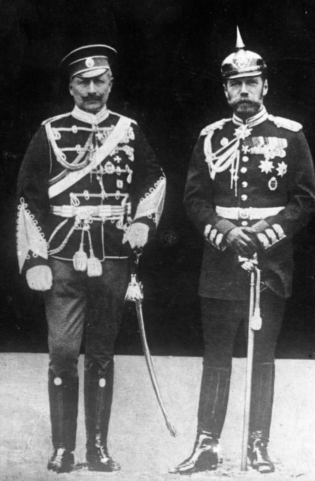
Tsar Nicholas 11 of Russia, King George V of the United Kingdom and Kaiser Wilhelm 11 of Germany were cousins and had fairly surprising and good relations before The Great War here is a picture of Nicholas and Wilhelm wearing the military uniforms of each other country in 1905.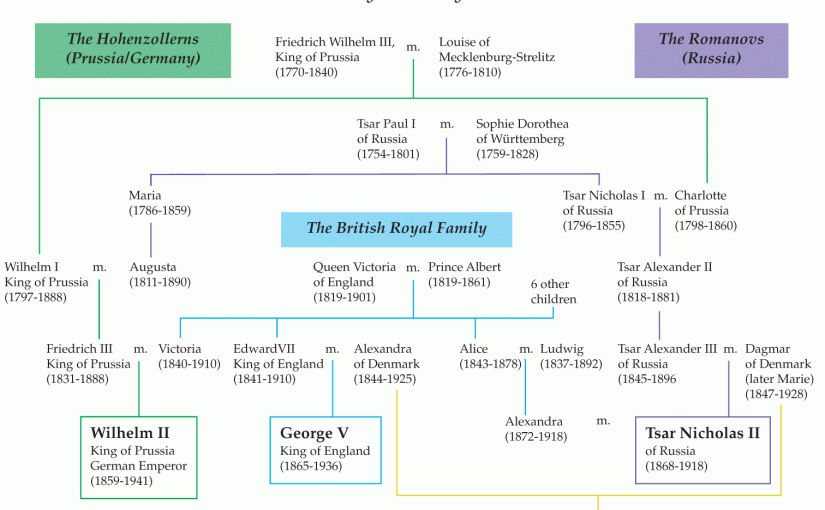
The Treaty of Brest-Litovsk
The treaty of Brest-Litovsk officially ended Russia’s participation into the war and was signed March 3rd 1918. It made Russia recognise the independence of Finland, Georgia and Ukraine. For Russia to give up Poland, Belarus and the baltic states to be occupied by Germany and Austria-Hungary until the end of the war on the western front. The Ottomans were given back the land they lost in the Russo-Turkish War in 1878 and for Georgia, Arminia and Azerbaijan to become one whole puppet state of the Ottoman Empire. Finally for Russia to pay 6 billion Russian rubles to Germany.
The Big 4 Treaty of Versailles
The Great War officially ended on June 28 1919 with the Treaty of Versailles which was dominated by the big 4 (Italy, America, Britain and France). America wanted to create the League of Nations and get rid of there monarchy and replace it with the Weimar Republic. Italy wanted colonies from Germany in Africa, the new country of Austria would be forbidden to unite with Germany and Troyl, Dalmmatia and Istria. The British wanted to divide Togoland and Cameron with the French in Africa, the dismantle meant of the German navy, German South-West Africa and mainland New Guinea. France was the harshest out of the 4 and wanted to divide Togoland and Cameron with Britain, to gain lands they lost during the Franco-Prussian war of 1870 most notably Alsace Lorraine, for Germany to dismantle there Air Force, for Germany to pay 132 million gold marks to France, to occupy the Rhineland and restrict there military to 100,000 men. After it was ready Italy wasn’t given any colonies.
The French Army Equipment The First World War
At the outbreak of the first world war the french army used old school tactics including marching in columns and red trousers, dark blue tunics and no helmet. During the war the french used the bolt action rifle the Lebel M1886 as there standard issue rifle however later on in the war it was replaced by the Berthier M1916 rifle and the Chauchat M1908 as there main Machine gun however it would gam, only have 20 rounds in each magazine and had a slow fire rate the french soldiers even said “I would rather use my bare fists instead of that crap” so they often used the British Hotchkiss M1914 instead. However as the war progressed the french used the RSC 1917 which was a new invention one which would be known as the semi-auto rifle and the Ribeyrolles M1918 which was there first sub machine gun. The French army also used the Browning M1900 pistol which was produced in Belgium. The French army had the most amount of different tanks in the war. There first was the Renault FT17 light tank which was the first tank being built and was planed to be a light armoured vehicles which could be used to out flank the enemy and the turret design was used by lots of nations during World war 2 however the British beat them to putting it out on the battlefield producing the Mark 1 land-ship. When it was ready in 1917 another tank was being built by the French Army the Saint-Chamond which was more similar to the British land-ship than the FT17 and also the tank which never reached the battlefield in time the Char 2C which would tower over the crew. 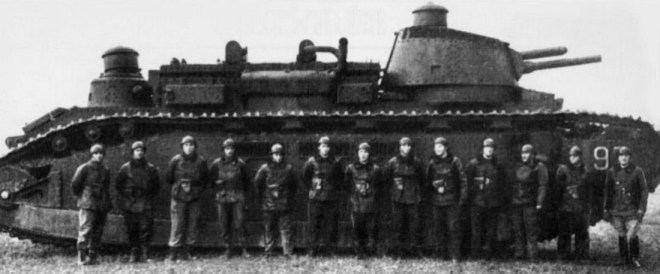 As for headgear the the army used the the M1902 Horizon Dark Blue and Red Kepi, M1914 Horizon Light Blue Kepi and M1915 Adrian helmet. The French Army used a dark blue tunic and red straight leg trousers in the first 3 months of the war however they used the same style tunic in late 1914 to 1916 but with the new french colour of light blue, light blue straight leg trousers and brown boots. surprisingly the French used the light blue P017 Tunic which was based off the German P010 Tunic in late 1916 to 1918 with the same straight leg trousers as 1914 and black boots.
Henry Tandey who was he and why did he play a role in the 20th century?
Henry Tandey was the man who save Adolf Hitler in the 5th battle of Ypres on the 28th of September. Neville Chamberlain was the first to notice after his meeting with the Fuhrer. Adolf Hitler had a painting on his study wall of a British solider who was recognised to be Henry Tandey carrying english soldiers to safety. After Henry found out he quoted “Just my fucking luck, I was the only one being nice, and look what this bastard did.” hitler also quoted earlier on in his life “That man came so close to killing me, I thought I would never see Germany again.”
Because of this one private hitler came to power to cause the second world war however it is debatable whether someone else would started the war but that we can never know.
The Austro-Hungarian Army Equipment the First World War (Great War)
The Austro-Hungarian Army was a poorly led army due to the different languages spoken in the empire however they had a variety of different uniforms and weapons in the war. The army used the Gewehr M.95 as there standard issue rifle and the schwarzlose machine-gun and officers used the Mannlicher M1905 pistol. For headgear the army wore the Feldkappe, the red Fez for the muslim minority of the country, the Berndorf-helmet and later on in the the war they used the M1917 Stalhelm in a gold texture. They used a grey or blue tunic, a Sam Browne belt, straight leg trousers in grey or blue and black boots.
The Ottoman Army Equipment The First World War
The Ottoman Army was very experienced at the start of the War because of both Balkan Wars and Italo-Turkish War however this meant the army was exhausted and had low morale but still had enough weapons to supply there troops. The standard issue rifle was the Mauser M1877 and the German MG08 as there Machine-gun the officers also used the ottoman version of the Belgium Browning Model 1903 and carried a sword at there waist. The Ottomans never produced a tank but instead used captured British Mark 4 and 5 land-ships. As for head gear the army used the Kabalak helmet, the Kufiya hat mainly on the Palestine front, the 1914 Ottoman Sun Helmet. And in early 1918 they used the M1918 Turkish Stalhelm which featured no visor so they could pray for religious purposes but also to provide better vision and hearing for the troops. The Ottomans used the P010 German Model in tan as well as simple Ottoman tunics, and tan trousers, a brown belt with gold ottoman design buckle and long brown boots.
What this blog will be about
This blog will be about the Great War, Inter War period and World War 2 and occasionally other stuff like the Russo-Japanese War, The scramble for Africa and more recent history. It will also include important people who changed the course of history.
 The World Wars